Wednesday, April 15, 2009
Symbolism

Revolutionary Road
Anxious and round-eyed, two by two, they looked and they moved as though a calm and ordinary escape from this place had become the one great necessity of their lives; as if, in fact, they wouldn’t be able to begin to live at all until they were out beyond the rumbling pink billows of exhaust and the crunching gravel of this parking lot, out where the black sky went up and up forever and there were hundreds and thousands of stars.
This is when Yates had me hooked. This final line of the first chapter, so beautifully written and exquisitely crafted, was where I knew I would enjoy the hell out of this book even though the Oscar buzz had me aware of the content (“This novel locates the American tragedy squarely on the field of marriage” – Alfred Kazin) and stupidly, due to some unfortunate TV viewing, the ending got spoiled for me before I opened the first page. Also, reading it over again now having considered the novel as a whole, the sentiment expressed above from the first chapter read again in context of the entire novel is just a further testament to Yates’ symmetry and craft here. Obviously, this club has brought some weighty, emotional, and depressing literary business down upon us. However, I can’t help saying that I loved this book. Not just for the book club, but in life, people. It may very well be one of the best books I’ve ever read.
From what I’ve found, a lot of people respond negatively to Revolutionary Road, particularly women. This is a book that takes place before feminism (or at least before The Feminine Mystique) and I’ve read in many places that Yates himself was a “marital traditionalist,” which I think is perhaps just a nice way of calling him a chauvinist. Of course, that and the context and place in history where the story takes place, forces you to be a bit forgiving of some of this in your reading (or at least that was the case with me). The thing that really got me past this anti-woman message that so many claim is a prominent factor in the book is that fact that both of our protagonists are so deeply flawed. They equally contribute to their unhappiness as a unit and both of them are, in the end, kind of unlikable characters. April and Frank both are kind of fucked up. And, one of the central issues in the book, I think, is whether or not it is (at least entirely) their fault.
Obviously, they are both very unhappy people. It seems as though Frank is the kind of person who has that IT factor, something that draws people to him, a handsomeness and natural charisma. However, we're constantly forced to question just how "natural" that charisma is as he constantly is rehearsing conversations, speeches, courses of action in his head before he actually carries any of them out. April is in many ways the same, a natural beauty and talent who at heart is a romantic. She feels there is something better out there for her, but at the same time understands that her situation and the parlance of the times has her tethered to her husband, who she emotionally manipulates as much as he her. Throughout the book though, you feel this tremendous pressure from the world around them. They feel like they need to be or want to be the perfect bohemian intelligentsia that flies in the face of the suburban drawl that weighted down so many WWII veteran families in mid 50s. This pressure seems to come most notably in the form of the Givings ("She cried because she'd had such high, high hopes about the Wheelers... and now she was terribly, terribly, terribly disappointed") and this suburban funk in the form of the Campbells, who the Wheelers seem to detest but can't seem to shake themselves from. There really is just so much to talk about here and I want to see where this discussion leads us before I say too much more...
In the end, regardless of the questions of content and theme, what I really appreciated mostly was the craft of the book. The beautifully written sentences. The skillful and seamless handling of flashback as a way to move the story forward. The very seldom and difficultly used omniscient third person narration.Though Yates himself seems to have been a sad and unhappy man (I read his follow up to this, a collection of short stories called Eleven Kinds of Loneliness for Christ-sakes) there is no doubt that he was a superb wordsmith and, in the end, I think that kind of skill is necessary to keep a reader engaged throughout this kind of story.
Anyway, enough for now. I created a couple of posts below containing prompts for the facets of the book that I think could be interesting to discuss. By all means though, please have at it however you'd like. I'm really curious to see what everyone thought.
John Givings
Now you’ve said it. The hopeless emptiness. Hell, plenty of people are on to the emptiness part; out where I used to work, on the Coast, that’s all we ever talked about. We’d sit around talking about emptiness all night. Nobody ever said ‘hopeless,’ though; that’s where we’d chicken out. Because maybe it does take a certain amount of guts to see the emptiness, but it takes a whole hell of a lot more to see the hopelessness.
Structure
How does the structure of the novel serve the story? Two examples…
--You could make the argument that the novel begins and ends with a performance. First, The Petrified Forest, at the end Mrs. Givings’ “performance” for the Braces.
--The skilful use of flashback throughout. My favorite? From the last chapter of Part 2 to the first of Part 3.
Misc.
--What do you make of the role of alcoholism in the novel?
--What role do you think each of the Wheelers’ extra-marital affairs had both in terms of defining the story and each of their characters?
--What do you make of the role of parenthood in the novel and Yates' commentary of it? As exhibited by Frank's and April's parents, Frank and April themselves, the Givings', the Campbells'?
--I mean, can we avoid it: abortion? It comes up at two distinct points in the story and the lives of Frank and April. How is it used by the characters and by Yates throughout Revolutionary Road?
Wednesday, March 25, 2009
Dan's Choice #1
Monday, March 16, 2009
Our next discussion...
By all means feel free to keep the discussion of O'Nan going, but I thought I'd let you all know that i plan to put up my post on Revolutionary Road sometime early in the week on April 12th. That should give everyone who is interested about four weeks to get it read if you haven't started already. I've already finished, so if the general sentiment seems to be that we can discuss it sooner, by all means let me know. I found it to be a really easy and engrossing read.
Also, if anyone is interested, many people theorize that the return to literary grace that Yates has had in the last ten years or so (most of his books were out of print after his death in '92) was due mainly to this piece in the Boston Review written by, strangely enough, Stewart O'Nan.
Happy reading!
Sunday, March 1, 2009
First post for "Last Night"
Friday, February 27, 2009
Funny Enough...
And while I'm here, and if anyone's interested, I'm planning on watching, by, say March 15, Le Cercle Rouge, the 1970 French crime caper directed by Jean-Pierre Melville that's famous for its 35+ minute heist sequence. Criterion has put out an edition, but I doubt that's what Netflix'll send me. I'd be interested in discussing it if anyone's interested. Otherwise, my cat can get my two cents'. Here's a trailer to whet your appetite, francophiles:
Tuesday, February 17, 2009
Revolutionary Road

Seeing as how I will be involved in 2 different 4+ hour plane trips in the next week and will have a lot of time for reading (and I guess to give everyone a heads start if they want it) I've decided upon the next book, Revolutionary Road by Richard Yates.
Now most buzzed due to the recent Sam Mendes adaptation with Leo and Kate, the book is highly acclaimed and, in keeping with our winter theme, I'm assuming ends tragically.
From NPR:
Frank and April Wheeler, the protagonists of Richard Yates' 1961 novel Revolutionary Road, are, in the most basic sense, ordinary people. He works in the city in what he calls "a hopelessly dull job;" she's a stay-at-home mother of two. They live on the street that gives the novel its title, in a cookie-cutter suburb in Connecticut.
In the 300-plus pages of the novel, nothing all that extraordinary happens to them, at least not until the end: Frank and April deal with dissatisfaction and fear, with pregnancy and ambition, and with the dream of escape. Yet in spite of this lack of surface pizazz, Revolutionary Road seems, each time I read it, ever more moving, and ever more an essential testament about mid-20th century America.
Sounds like a treat, but it's something I've wanted to read since Woody Allen mentioned Yates in both Annie Hall and Manhatten. Plus, it was nominated for and then lost the National Book award the same year that Catch-22 did the same. So it has some pretty nice company.
Now, please, continue to consider the Last Night at the Lobster.
Monday, February 16, 2009
A Thought.
In that same vein, I was thinking about movies. There are plenty of 'em out there that I haven't seen--or heard of--and want to, so why not turn this utterly pleasant blog business into a book/movie club? We all read at different paces, but movies are watchable at pretty controllable intervals, no? I'd like to think we could roll movie discussions into this blog pretty seamlessly. But hey, Christ knows I've been wrong before.
We could have movie themes (British heist movies, sports movies, love stories, literary adaptations, Harryhausen movies, director-centric, B-movies, zombie flicks, documentaries, ad infinitum ). We could go birthday-by-birthday selections, or whatever.
OR, I could take my wares elsewhere and do a movie blog all on my own. I'd like to think I'd be able to drum up interest beyond the five-ish of us who contribute here (and I'll try regardless), but I wanted to get you all in on the potential ground floor just in case. We seem to be good at discussing shit.
This idea's been kicking around for a while, and it seems pretty thematically relevant to you all. But if I'm wasting your time and if this club is a book-only club, sorry, truly, and I'll take this post down ASAP, but just in case this isn't a terrible notion, then let's do yes.
Could we possibly be a Culture Club?
Thursday, February 5, 2009
Not to kill the current discussion
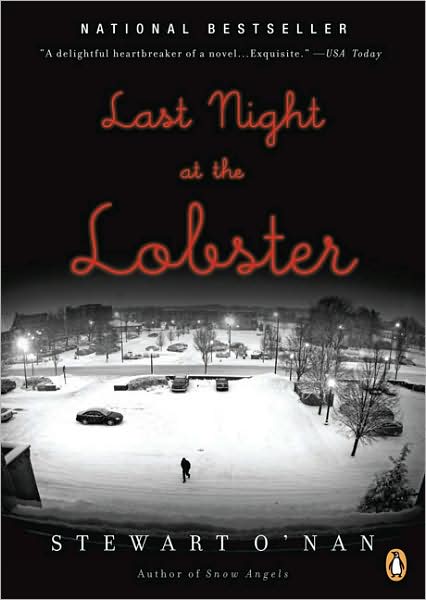
It has been requested that I post the next title, which is "Last Night at the Lobster" by Stewart O'Nan. I'd love to add a picture of the cover as well as the publisher's blurb about it, but I've been trying to figure out how to do that for the past ten minutes and now I have to leave for work. Rest assured that it is both short and set in present-day America.
Now by all means continue discussing Johnny.
Edit: Added in the picture and publisher blurb - PAK
"Perched in the far corner of a run-down New England mall, the Red Lobster hasn't been making its numbers and headquarters has pulled the plug. But manager Manny DeLeon still needs to navigate a tricky last shift. With four shopping days left until Christmas, Manny must convince his near-mutinous staff to hunker down and serve the final onslaught of hungry retirees, lunatics, and holiday office parties. All the while, he's wondering how to handle the waitress he's still in love with, his pregnant girlfriend at home, and where to find the present that will make everything better."
Tuesday, February 3, 2009
Authorial Intent
I guess I'd argue that both have to be read in context to get their full impact, and considering how little social context any of us have for 1960s New Orleans or, jeez, 1938 anywhere, I think we've given ourselves a doozy of a one-two punch to open up this here book club. But I'm definitely enjoying the debate it's bringing.

 Posts
Posts

