Thursday, July 30, 2009

Style and Structure

I suppose as good a place to begin as any is with the thing that could make or break Gilead for its readers: its style. There are really two halves to this book - the first rooted mostly in the past, and the second focusing primarily on the present. Similarly, when the focus shifts from the past to the present, Robinson's method of storytelling shifts as well. Gilead is mostly narrative in the beginning - a series of letters to his son, the subject of which often seem random until we read a bit further and see how each observation or memory leads to another. This way, themes, symbols and plot threads are introduced and woven together to form the core of the novel. Later, when the focus shifts from Ames's family history to the return of Jack Boughton, the style shifts to something a bit more familiar - more dialogue and plot here than the largely stream-of-consciousness method employed in the beginning.

So, some questions:

What did you make of Robinson's method of storytelling? Did it work for you, or did it feel like a slow, meandering mess? Furthermore, in what ways did the changes in style reflect the changes in John Ames?

Fathers and Sons

"A man can know his father, or his son, and there might still be nothing between them but loyalty and love and mutual incomprehension." (7)
A prevailing theme in Gilead is the relationship between parents and their children, and in particular between fathers and sons. Often there's a tension at the core of those relationships, and it's that tension that influences the sons' future beliefs. Since there are so many facets to this theme thanks to the great number of parent/child combinations, I thought the most logical place to begin was with John Ames and his relationship with his son - who he is confident will be become "an excellent man," but who he claims he "will love absolutely even if you are not" (73) vs. his relationship with his namesake, John Ames Boughton - old Boughton's "Prodigal Son" and the godson John once claimed he "was never able to warm to" (188). What might account for John's ability to forgive one son of anything versus his struggle to forgive the other for anything? In what way is John's history with his brother, father, and grandfather affecting these present-day relationships?

Human Nature

The consistency of human nature becomes a core question in the novel's second half. At one point in the novel (pg. 151-153) Jack forces the question of whether or not a person can ever really change, leading John to admit that he believes a person can change their behaviors, but never his essential nature. John's wife disagrees, saying "A person can change. Everything can change." So, what do you think? Can we ever really change our natures? Did Jack change? What about John? What might account for John's opinion on this issue vs. his wife's?

Additionally, how does this question of the changeability of a person's nature affect another major theme in this novel: Forgiveness?

Symbolism

Although I noticed several symbols working in Gilead, it struck me that the most dominant one was water - baptismal water, rainwater, water from a sprinkler, tears, lakes, etc.

In particular, three passages spring to mind: the story of the slave tunnel that collapsed and turned into a lake (58-63), which is then followed with John's observance of his son playing in a sprinkler (63), which is followed with the story of how John's mother washed his grandfather's shirts (80-81). How does water operate on a symbolic level in this story? How might it connect to some of the novel's larger themes?

Locations

In the Bible, Gilead became the home of one of the twelve tribes of Israel, and thus a safe haven for those who were "lost in the wilderness." In what way is this an appropriate title for this town? For this novel? How does Kansas (and the story of John's abolitionist grandfather) factor in?

Misc.

Since an argument can be made that this novel is really a long character study, I'm curious what everyone thought of the narrator. He's old and wise, but also clearly flawed. What do you make of his flaws? Are they forgivable? Did he resolve them?

What of his tendency to illustrate his points with religion - did John come off as too "preachy" to you?

What about the role of religion in this book? We're not an overly religious group of people, so I'm curious to what extent this may have affected your reading of the novel. Also, I sensed a very clear line drawn here between religion and faith. (And there's a question in there somewhere. I'm just not entirely sure yet what it is...)

What about the role of racism and slavery in this book?

What about the importance of names in Gilead - both namesakes and those characters who are never (or hardly ever) named?

Monday, July 13, 2009

We are so far ahead of Newsweek, we're behind them

I think it's interesting that in this week's edition of "Newsweek," the editors name our current novel Gilead one of the top 50 books to read now. Nice work, Maggie!

Thursday, June 25, 2009

Gilead

Hello, friends. To those of you who have been faithful participants in our very special book club: thank you. I'm having a lot of fun reading and talking books with you, and I very much hope you feel the same.

My number has come up in the book selection process, and as I've previously stated I would like us to read Marilynne Robinson's Gilead. She's an author I've been meaning to get to for some time now, and I figured there's no better place to start than with the novel that earned her a Pulitzer.

Gilead is written in the form of a letter from John Ames, an aging Iowa preacher who believes his time is this world is running short, to his young son, a product of a late marriage. The New York Times describes it as "religious, somewhat essayistic and fiercely calm. Gilead is a beautiful work -- demanding, grave and lucid," and The Washington Post says it's "written in a prose so gravely measured and thoughtful, that one feels touched with grace just to read it." We've read a lot of different things so far in this club, but we've yet to read anything by a female author, nothing that could be classified as spiritual, nor anything that can safely be called "beautifully ruminative." I say it's time.

Sunday, June 7, 2009

Random Notes

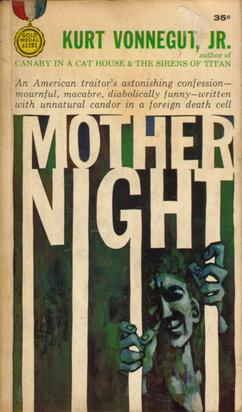
I thought that this was an enjoyable read, but still covered a serious topic. I found a more serious tone to this novel compared with some of Vonnegut's other novels, but maybe just because I was reading more critically than I sometimes do.

Symbolic Names

What does everyone think of the names? Campbell as American as the soup? Krapptauer=Crap Tower? What's the deal with "the Black Fueher of Harlem?"

Destiny vs. Choice

Is there a stronger argument for free will or free will? Which one wins? If Campbell had all of these events fall into his lap, was this his destiny? Did he "choose" free will in the end by hanging himself?

Innocent?

Even if the story were true, is Campbell really innocent? Are people who allow themselves to manipulated in such a way innocent of the crimes that they commit? Were the German citizens not guilty of the Holocaust in some way?

Hoax?

Are we supposed to think that this whole story is a hoax, somehow thought up by Campbell to prove his innocence? If not...is this a plausible story? Could there really be a vast conspiracy with the Americans, the Russians, and the Jews? Did Resi really fall in Love?

Tuesday, May 26, 2009

Thursday, May 7, 2009

FInal Note on Yates

The RR discussion fell at a hellish time in the semester for me and perhaps there was a bit more that I wanted to say. Though I'm a bit past it now, Steve just handed me yesterday the Mar/Apr issue of The Believer magazine which contains an interesting interview with Sam Mendes primarily concerning his adaptation of Revolutionary Road (which I have still not seen).

You can't get the full interview online, but there are two Mendes quips I'd like to share so we can put a nail officially in the RR coffin. The first concerns a level of symbolism I didn't pick up on, the other an interesting dissection of the story structure in general.

"Yates describes Route 12 [if I remember correctly, the route leading to Revolutionary Road] cutting through the countryside at the beginning of the novel and he sets the house right on the border of the woods... the same woods April runs into when she's trying to escape from Frank toward the end. There's that deliberate sense of being right on the edge of centuries of nature and yet also within a very sterile and new environment."

"The story starts in such crisis. Anyone who's directed a Shakespearean tragedy or anything that involves characters spiraling down into chaos and despair can deal with that particular shape of story. But the strange thing about the novel Revolutionary Road is that is starts with despair. The story has a pyramid shape: starts bad and goes up in the middle when they decide to go to Paris, and then it goes back down again, but deeper and much darker that before. [The difficult thing about Yates is] his default position is to go dark."

Agreed.

Now, when do we move on to the lighter good Dr. Vonnegut?